· 11 min read
The GPU Already Lost This Job Once
I made money flipping mining rigs as a teenager and lost some of it holding the last ones too long. The AI build-out is running on the mistake I made with the last ones.
CoreWeave raised $8.5 billion of debt in March to buy more GPUs. And if CoreWeave can't rent them all out? No worries. Under an order form it filed with the SEC last September, "NVIDIA is obligated to purchase the residual unsold capacity through April 13, 2032".
It reminded me of another wave of infrastructure investment and depreciation: bitcoin mining. At fourteen I started buying bitcoin miners with my own money, the USB kind with a massive heatsink on top, and I made a lot of money flipping cloud mining rigs before I burnt myself holding onto the last ones too long. The miners themselves never broke. What got them was a line on a spreadsheet, and the H100s are sitting on that same line today.
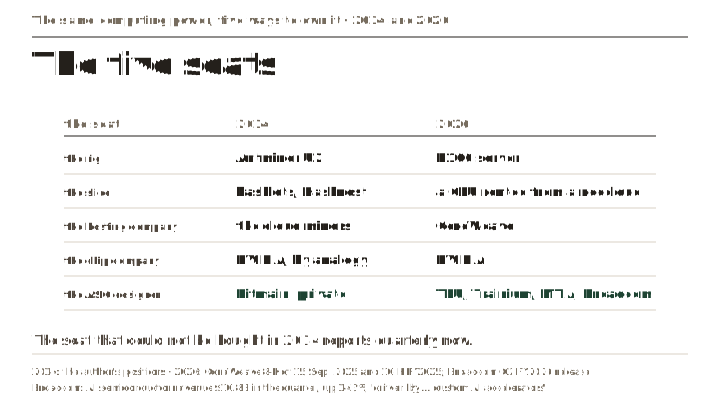
Fairly quickly I worked out that the machine on my desk was only one way to own the thing I actually wanted, which was hashrate. In general, hashrate investment opportunities fall into five seats:
- Rig owners, who buy and operate their own ASICs
- Slice owners, who buy terahashes from other people's rigs
- Host owners, who buy shares in the companies that run the facilities
- Chip owners, who buy shares of the chip makers
- And a fifth seat, the one I was fairly sure took most of the money: the ASIC designer itself. Bitmain was private, so nobody could buy it.
For about two years, I traded between the first four. I learned how to separate wheat from chaff by spending many hours on forums like Bitcointalk.
All five seats exist again. The rig is an H100 server. The slice is a GPU rented by the hour from one of the so-called neoclouds, the compute hosts that sell people access to slices of GPUs. The host is CoreWeave, and you can buy its shares. The chip company is NVIDIA, currently king. And the fifth seat is the TPU, Trainium and MTIA, the chips Google, Amazon and Meta build for themselves and keep captive to their own clouds. This time you can buy into it anyway, because Broadcom builds a lot of them and Broadcom is listed.
2013#
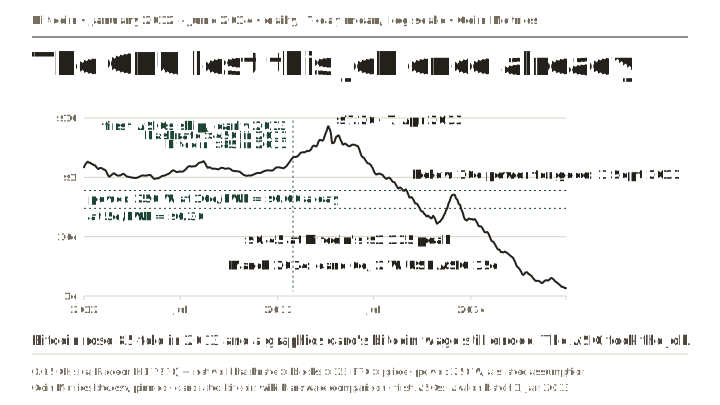
In 2012, gamers' Radeon 7970 graphics cards could be used for bitcoin mining, generating $1 to $2 a day. But in January 2013 the first ASICs came out, purpose-built chips that could only do bitcoin hashes. During 2013 the network's total computing power increased about 450 times, and the price of bitcoin increased 85 times, from $13 to over $1,100.
So this was the best year bitcoin has ever had, and the 7970's wage still collapsed. It briefly made $7 a day in the April run, had its last day above its own power costs by the start of September, and made 45 cents on December 4th, the day bitcoin peaked at $1,135.
My machines#
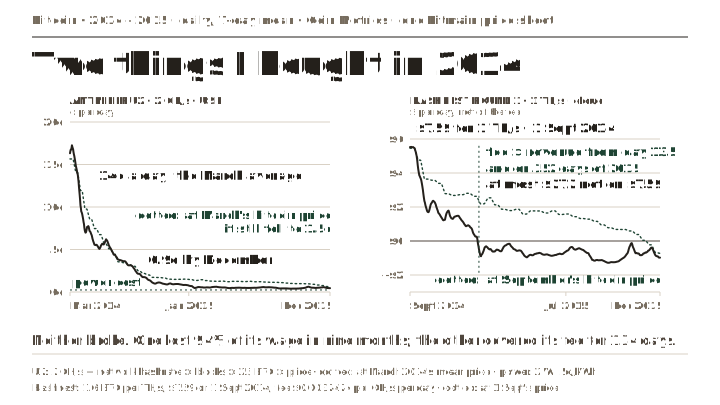
The Radeon's 250 watts generated 6 cents a day by March 2014. A tiny, two-watt Antminer U2 USB miner generated 15 cents.
The U2 generated 5 cents a day by June and 1 cent by December, and bitcoin was still trading at $379, so the price wasn't the main thing. In March, bitcoin's price had hovered at $567. Even if the price had stayed there all year, the U2 still ended it at a cent and a half.
My U2 sat in a laptop in a school library and made fifteen cents a day. Nothing about it changed. It hummed away at the same hashing speed, but by December it made a measly cent a day.
The U2 did not lose money, electricity costs considered, but it wasn't making me rich.
What happened? The U2 had competition. The bitcoin network adjusts the difficulty of mining every 2,016 blocks, about every two weeks, to compensate for increases or decreases in total computing power applied to the network. In 2014, computing power hit a new all-time high eleven months in a row. My little U2 was insignificant.
But I'd moved on to GAW Miners. This fraudulent operation sold $20 million of "hashlets", a promise of future earnings, to more than 10,000 people in five months. Hashlets were touted as "always profitable and never obsolete". They were transferable between people. They promised to pay out every single day. People on Bitcointalk kept asking which pool the hashlets were even mining in. Nobody could find one. The SEC later concluded that GAW Miners "directed little or no computing power toward any mining activity".
I got lucky with GAW Miners though: I got out of hashlets a few months in with a profit.
GAW Miners' hashlets promised daily payments forever. So did the legitimate contracts from Bitmain's Hashnest. That was the one I held too long.
On 1 September 2014 you could buy 1 TH/s for 1.6 bitcoin on Hashnest, about $759. The contract also cost $3.24 a day in US dollars. It made more than its cost for 134 days and failed to do so on day 135. It failed to do so on 352 of the 365 days of 2015. At its best it had returned $272, less than half of its original $759 cost. It still never made a profit. Bitmain made better chips every few months, chipping away at the value of those it'd already sold.
The only reason that contract ever made any money was that people believed bitcoin would keep going up forever. Sounds like CoreWeave and NVIDIA to me. That's the part of the AI demand story people don't seem to want to believe.
The one I didn't buy#
Next came Ethereum. Ethereum launched in July 2015 using a memory-hard algorithm which made ASICs unfeasible, breathing new life into GPUs that'd been collecting dust since bitcoin squeezed them out in 2013.
I didn't jump on that bandwagon. Within six weeks, Ethereum's developers put a difficulty bomb into the codebase, a feature of the code designed to make mining harder over time and encourage Ethereum to leave proof of work behind. The people I trusted on Bitcointalk took the bomb seriously, and so did I. Financing a machine whose job has a scheduled end date felt mad.
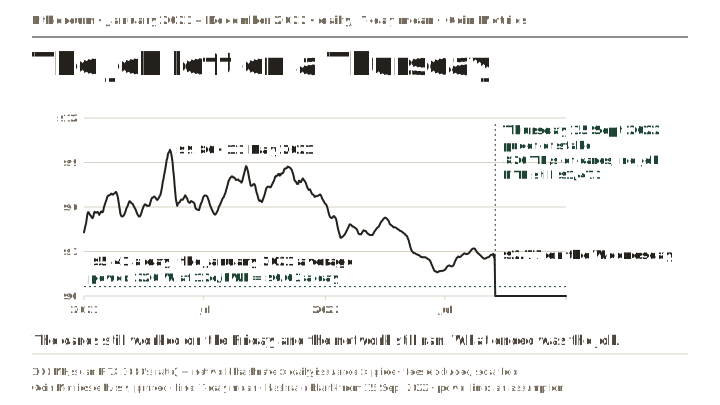
The bomb was disarmed six times in the seven years before The Merge, when all GPUs stopped making money on Ethereum. In its best week, in May 2021, a stock RTX 3080 made $9.86 a day. On Wednesday 14 September 2022 it made $2.77. On Thursday morning, block 15,537,394 took it and all 826 TH/s on the network to zero, with ether trading at $1,472. But the cards worked perfectly fine afterwards. They just weren't making money. The job ended in one block.
Three clocks#
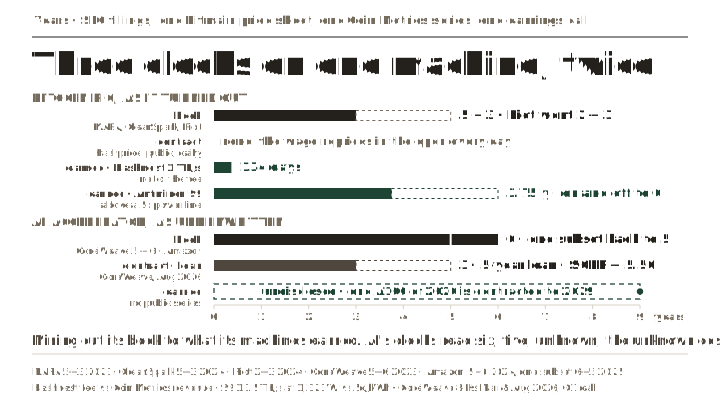
Every machine has three clocks. There is the book life the accountant picks, there is the contract the customer signed, and there is how long the thing actually earns, which nobody publishes. Depreciation is not about wear and tear. It is about obsolescence, the point at which your machine will not earn its keep because something better has turned up.
The best example of this came during the boom in bitcoin mining, where the third clock was public, so the book had to follow it. MARA and CleanSpark have since adjusted the useful lives of their rigs from five years to three. Riot has moved theirs up from two to three.
In AI the books went the other way. Amazon shortened the book life for some of its servers to five years and took a $1.4 billion depreciation charge that year, writing that it was "due to the increased pace of technology development, particularly in the area of artificial intelligence and machine learning". CoreWeave assumes a useful life of six years for GPUs for accounting purposes. Whether those GPUs will still be earning in six years is the whole question.
The same seats, with more money#
In January 2026 NVIDIA agreed to buy another $2 billion of CoreWeave equity. CoreWeave's March $8.5bn of investment grade debt is priced SOFR+2.25%, has a final maturity in 2032 and was underwritten based on customer contracts that match the duration of the loan. In August, the company priced a five-year loan for $2.6bn that's below investment grade and is priced SOFR+5.50%. CoreWeave's customer contracts there match an average duration of three years.
This circularity reminds me of Hashnest at a smaller scale. Under a $6.3 billion order form filed with the SEC back in September 2025, "NVIDIA is obligated to purchase the residual unsold capacity through April 13, 2032". As the August press release notes:
By financing these shorter-date commitments, lenders are signalling confidence in the long-term value of NVIDIA GPUs running on CoreWeave's cloud platform and a willingness to underwrite renewal risk.
I don't need demand to fall for this to go badly. The August loan runs five years against contracts that average three. That leaves two years, from roughly 2029, with the debt outstanding and nothing contracted against it. If the rate those GPUs command in 2029 is below what the loan costs, a leveraged owner cannot wait for a better year. It sells into whatever market exists that month, alongside everyone else whose paper matured on the same schedule. That is how a gradual shift arrives as a sudden one.
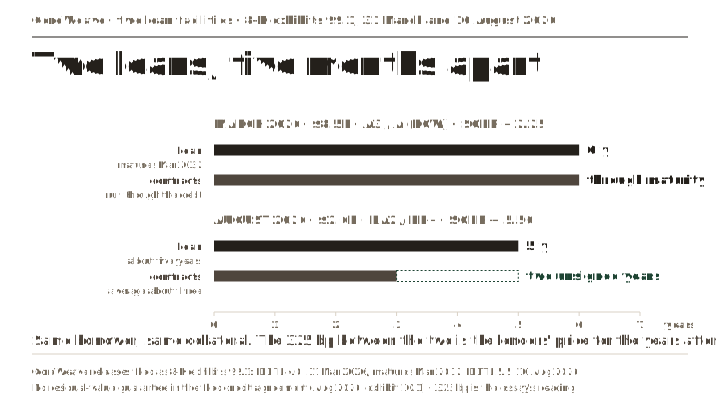
The 325bps of additional pricing between CoreWeave's March IG bond and its below-IG August issuance isn't zero. It is compensation for lower credit quality, and for the lack of contracted revenue covering the final couple of years of the August issuance. Those last two years are the part nobody has priced in public before. NVIDIA is an equity holder and has undertaken to buy the residual unsold capacity under that one order form, which is not the same as a guarantee on what the fleet is worth. There is no residual-value guarantee in the credit agreement.
The circularity is a bit awkward but CoreWeave has NVIDIA's support. This is ultimately a bet on GPUs lasting longer than everyone thinks. CoreWeave's chief executive, on the second-quarter call:
The fact that we have been able to go ahead and sell a GPU whose architecture was from 2020, in a contract that was fully priced out to 2029, really provides some insight into what the future is going to look like as this infrastructure comes off contract.
I do find it remarkable that a GPU could stay relevant for nine years. The H100 rental index has fallen 57% in under three years. One-year compute prices are 38% off the October trough because supply is still tight, and capacity has been booked out since February. If that holds I'm wrong, and honestly I'd be happy to be. Industry-wide, the repayment of GPU debt is a bet on GPU rental income.
So are GPUs durable assets that will earn for a long, long time? It's not that simple, because predictable inference moves to custom chips. Broadcom reported $10.8B of revenue from AI chips in one quarter this year, up 143% year over year, mostly from custom accelerators. Amazon deployed 2.1 million AI chips last year, more than half of them its own Trainium. Meta is deploying MTIA. Google has been doing inference on TPUs for around a decade.
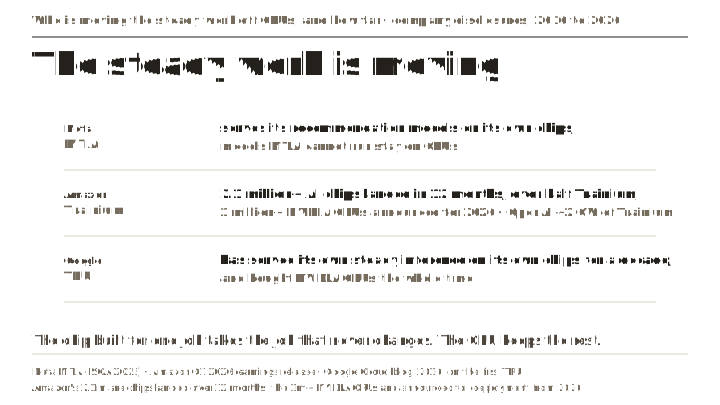
The counterargument is that last fact. Work has been leaving GPUs at Google for ten years and NVIDIA's data-centre revenue grew massively the whole time, with Google buying GPUs throughout. Workloads moving to ASICs doesn't break anything on its own, and Google can afford to watch GPUs fall out of its fleet because it earns about $100 billion a year.
What it does is expose whoever owns the fleet the work leaves, to the extent that they scaled up assuming demand would stay put and took on debt to buy the machines. The question is how long CoreWeave's workloads last before they migrate.
Caveats: CoreWeave is not MARA or any of the other bitcoin miners. I'm not trying to trash CoreWeave's stock or debt. I'm not even bearish. Just skeptical of their ability to roll this out without problems.
But I have watched a boom fail to save a machine twice. Bitcoin's price rose by a factor of 85 in 2013 and the graphics cards still became obsolete. Hashrate set eleven consecutive monthly records in 2014 while my U2's daily earnings slid from fifteen cents to one cent.
Like bitcoin ASICs, GPUs depreciate because technological progress makes them irrelevant. They don't have to be broken to be broken. The question is when the lenders notice.
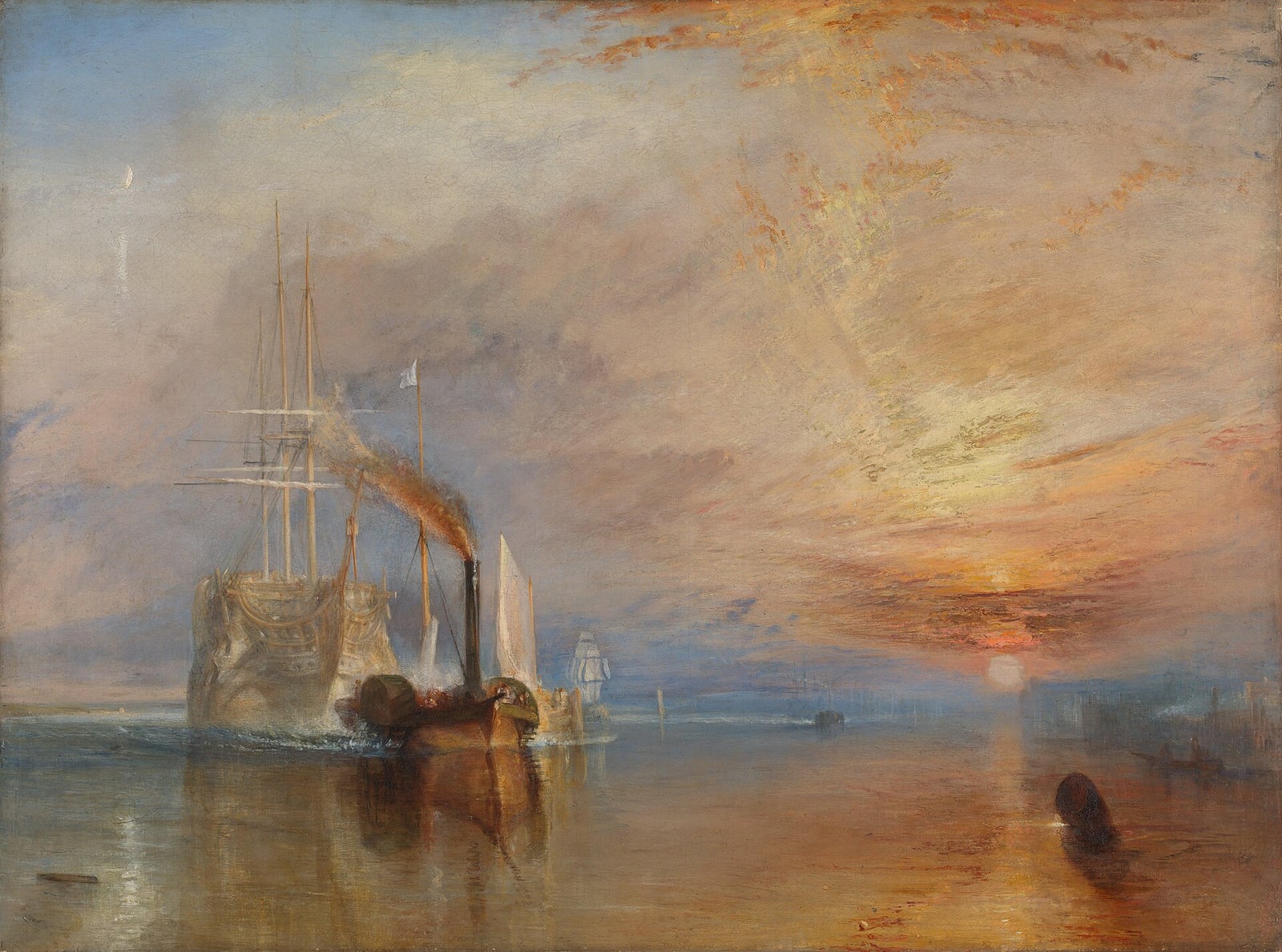
Turner painted the Temeraire in 1839: a warship with her masts still up, under tow to the breaker's yard by a steam tug. Nothing was wrong with the ship. The thing that had replaced her was doing the towing.
So point me to the customer and the workload, and maybe I'll buy more GPU racks. If the answer is "AI demand", I've owned this asset before, from four seats. It was a mining rig with better branding.