· 12 min read
Cathedrals and Europe's Case for Forward Deployed Engineering
Europe's best companies don't scale by removing humans from the loop. They scale by putting engineers back on the factory floor.
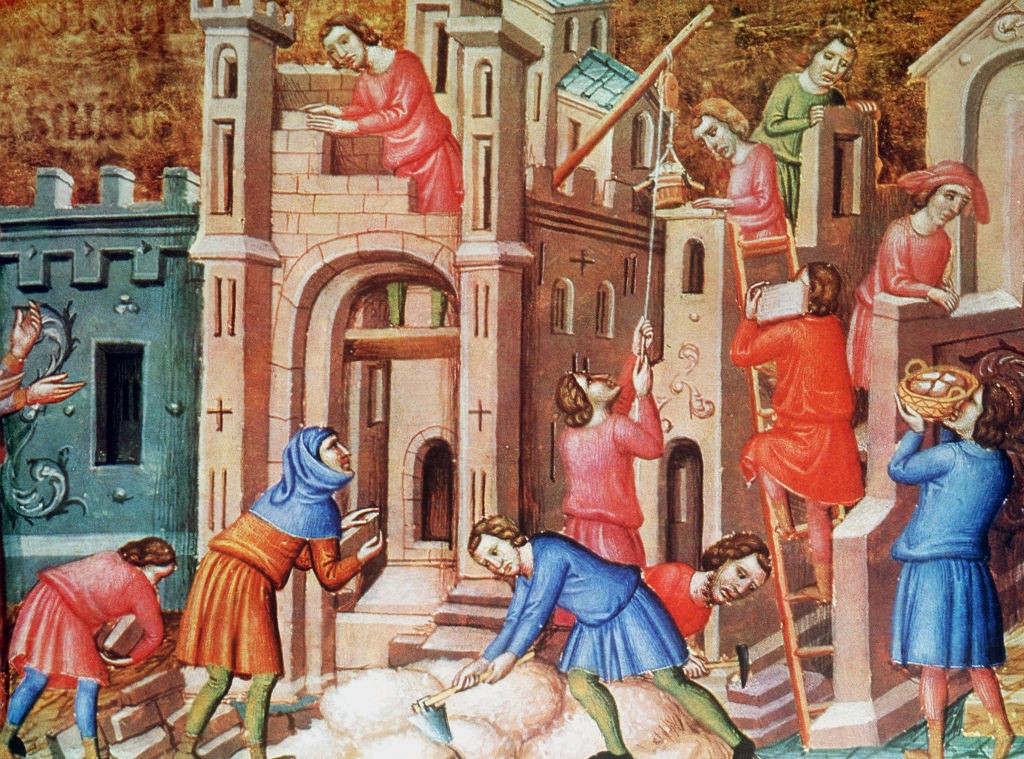
In 1174, a fire destroyed the choir of Canterbury Cathedral. The monks convened a commission of English and French architects. A chronicler named Gervase recorded what happened next. They chose a Frenchman, William of Sens, whom Gervase called a subtilissimus artifex, or "most subtle artisan," already renowned for his work on Sens Cathedral, one of the earliest complete Gothic buildings in France. William arrived in England carrying an entire structural vocabulary in his body: sexpartite vaulting, flying buttresses modeled on Notre-Dame de Paris, and a visual innovation that would define English Gothic for centuries.
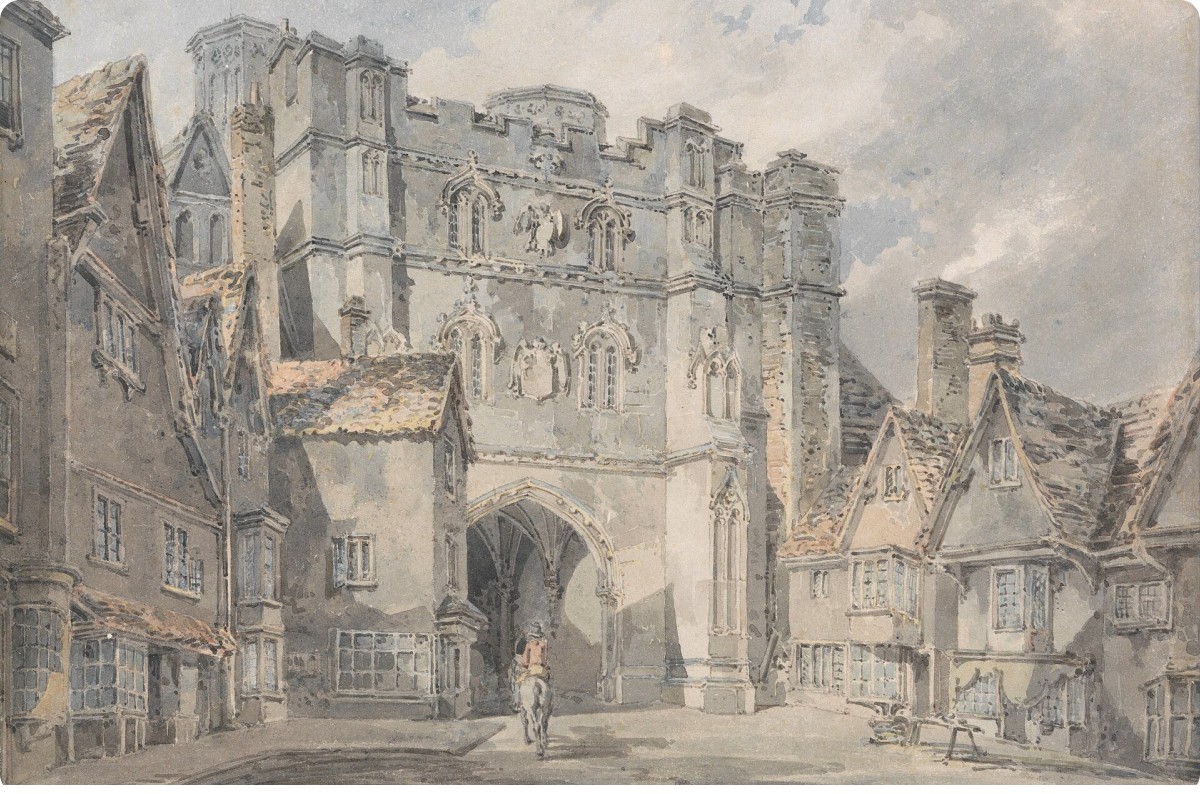
(Image: Joseph Mallord William Turner, Christ Church Gate, Canterbury, c.1830. Watercolour. Tate, London.)
William did not send plans. He came and fabricated the lifting machinery himself. He provided sculptors with wooden templates for cutting stone. He himself was the design, continuously present at the site, adapting to ground conditions, available materials, and the evolving demands of clergy who constantly changed their minds about what God wanted.
In 1178, he fell fifty feet from the scaffolding. He tried to continue directing work from his sickbed, issuing instructions through a deputy. But it proved impractical and he returned to France before he died. There were no comprehensive drawings to hand off. When the body left, the knowledge left with it.
This was how all of medieval Europe built. The master builder, maître d'œuvre in French, Werkmeister in German, wasn't just an architect. His presensence itself was the contract. For example, a 1253 contract for Gautier de Varinfroy at Évreux Cathedral specifies his salary and one condition: he must live in Évreux, never absent for more than two months.
Peter Parler was twenty-three when Emperor Charles IV summoned him to take over St. Vitus Cathedral in Prague. His family name derived from Parlier, literally "foreman." Their surname was their job title. Peter apprenticed under his father who worked at Cologne before inventing net vaulting at Prague: double diagonal ribs in a zigzag pattern no one had attempted.
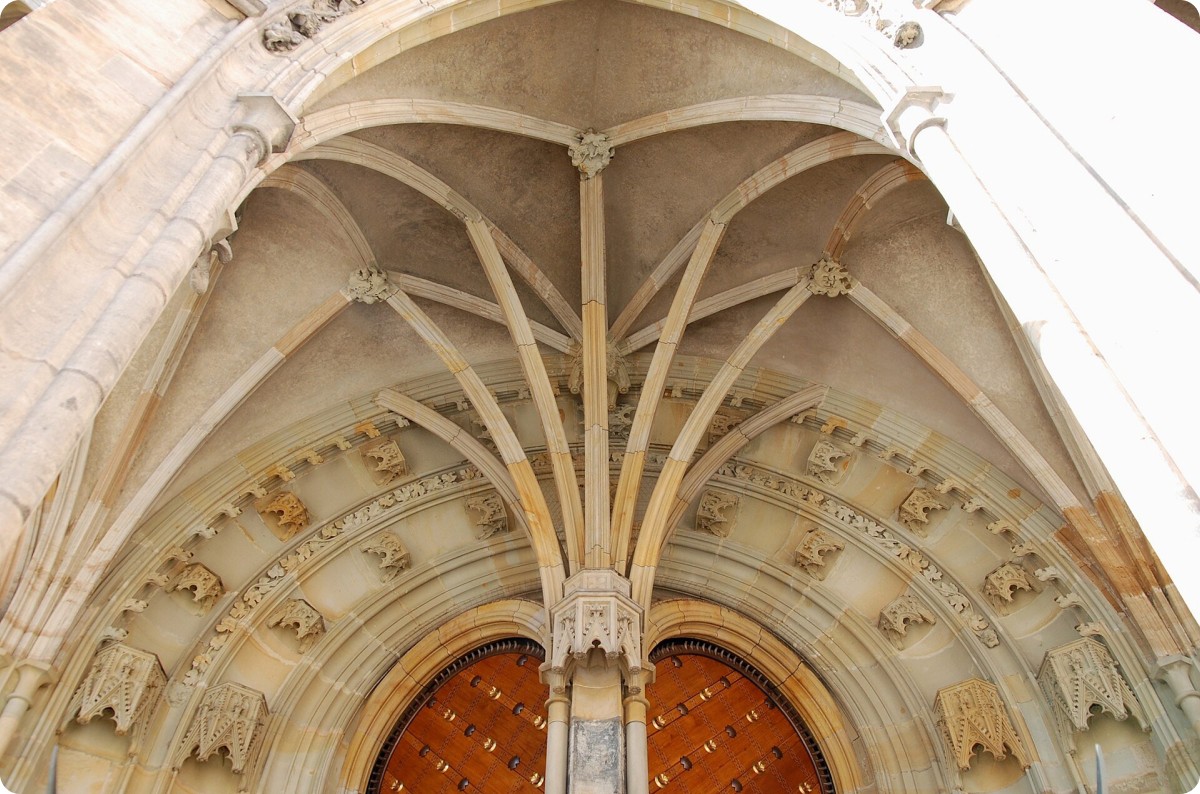
(Image: Golden Gate (St. Vitus Cathedral) in Prague)
His brother Johann became Master at Freiburg. Johann's son Michael took Strasbourg. Peter's own sons continued at St. Vitus, then Vienna, then Kutná Hora. The family's geometric innovations traveled wherever a Parler went. Each cathedral taught the next. It was a franchise operation eight centuries before anyone used the word.
The institution that made this possible was the Bauhütte, or the builder's lodge. Not a guild nor a headquarters. It's a self-governing community of masons, apprentices, and masters attached to a specific cathedral site, persisting for the duration of a build, which could mean centuries. The Bauhütte at Strasbourg operated continuously for over four hundred years.
Every cathedral was unique with different stone, different soil, different clergy, different city. Chartres sat on Lutetian limestone pulled from beneath the Paris basin. Strasbourg used red Buntsandstein from the Vosges. Each site forced the lodge to solve new structural problems with new materials under new constraints. And every solution fed back into the lodge's collective knowledge. A sculptor who carved the Beau Dieu at Amiens trained apprentices who spread his techniques to Reims, Bourges, and beyond.
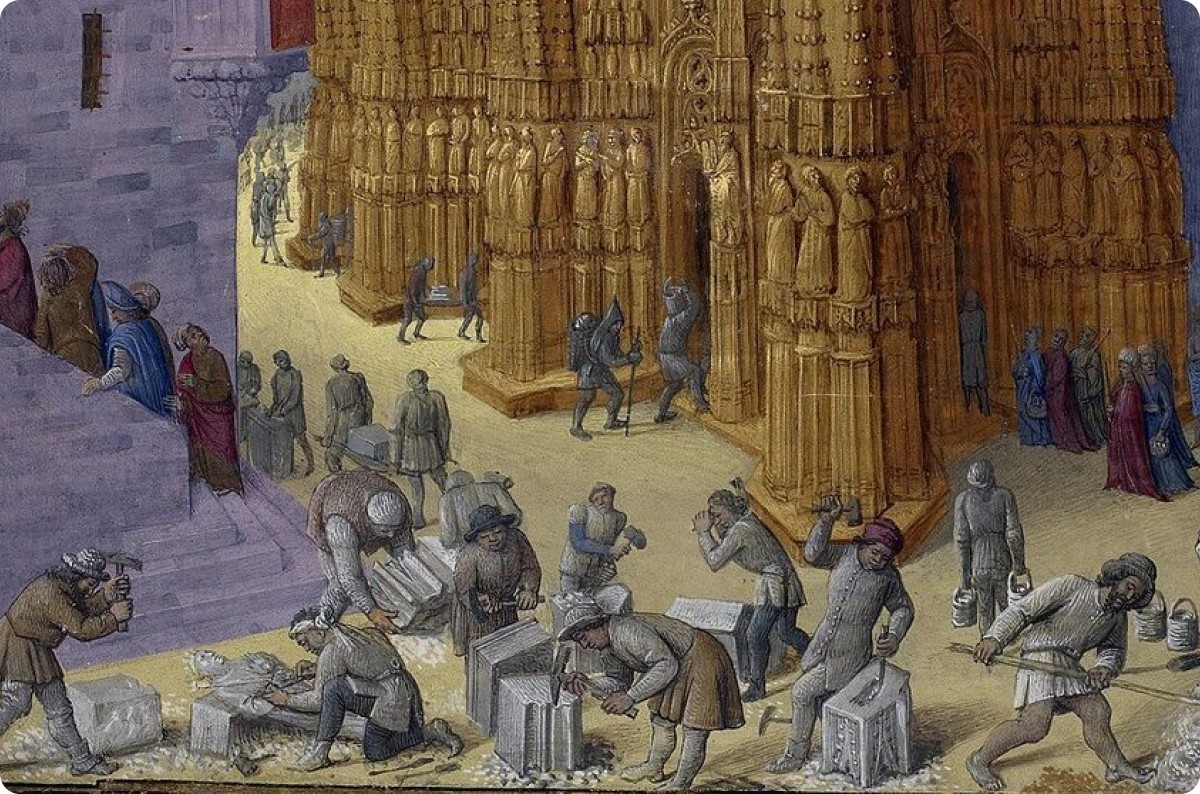
(Image: Jean Fouquet, The Building of the Temple of Jerusalem, c. 1470–1475. Tempera and gold on vellum. Bibliothèque nationale de France, Paris.)
Villard de Honnecourt, a Picard builder active around 1230, left thirty-three sheets of parchment documenting techniques gathered from Chartres, Laon, Reims, and Hungary. It's the only surviving record of how a medieval builder's mind moved between sites, accumulating and redeploying knowledge.
What looked like cost, sending your best people to a remote site for years, was actually R&D. Each deployment was a learning event. The lodge didn't just deliver a cathedral; it absorbed the problems of that cathedral and became more capable for the next one. The masons' marks carved into the stone at Rochester, over four thousand individual geometric symbols, one per mason, serving as payment tracking, were also a knowledge graph. Every marked stone was a record of who knew what, learned where, and carried it forward.
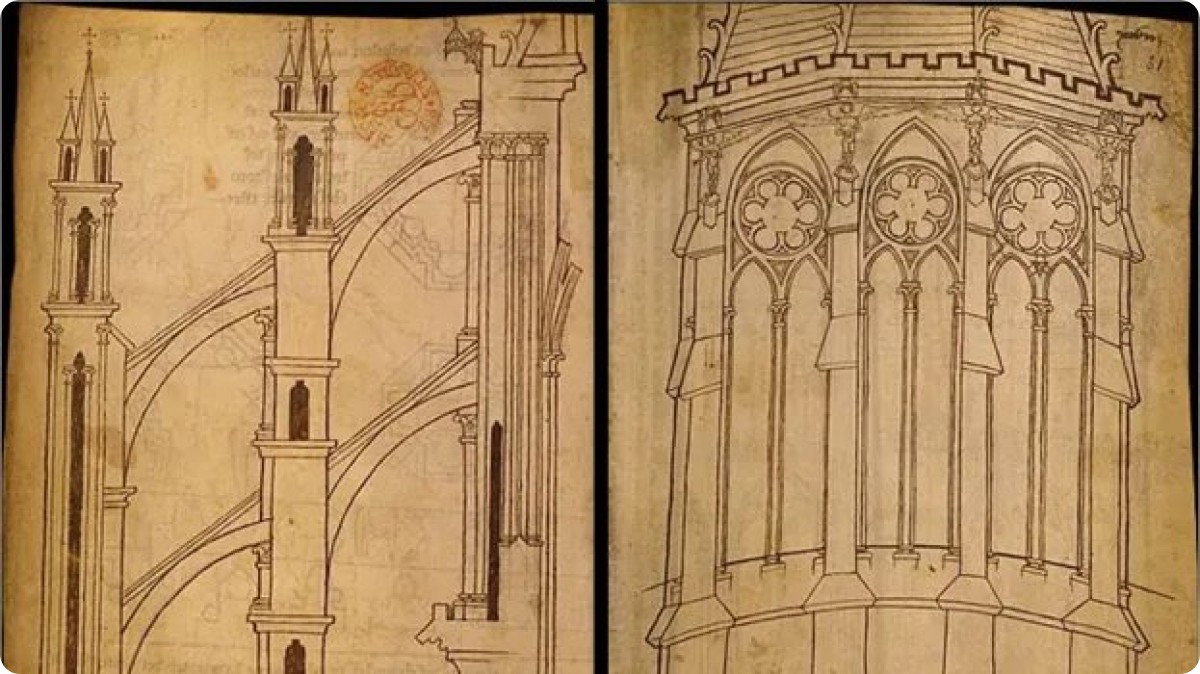
(Image: Villard de Honnecourt, Sketches of Masonry and Geometry, c. 1230. Ink on parchment. Bibliothèque Nationale de France, Paris.)
The Bauhütte was their core platform. It accumulated expertise and tools with every deployment and redeployed that expertise into the next site at lower cost and higher capability. Strasbourg's innovations showed up at Cologne. Cologne's showed up at Prague. Prague's showed up at Vienna. The lodges didn't scale by centralising. They scaled by compounding knowledge through deployed practitioners.
The cathedrals they had already built have outlasted every empire.
I'm writing about cathedrals today because I work in engineering, in Europe. And because the pattern I just described: deploy practitioners into the terrain, let them adapt to local conditions, let the knowledge compound through their bodies and their presence, is the oldest and most successful engineering model in European history.
It is the model that Europe is quietly rebuilding right now, at industrial scale, in the ugliest and most valuable terrain on Earth.
There's a story the Valley tells about Europe: "Europeans can't build winners. They have great universities but produce consultants. They have engineering talent but funnel it into corporates. They start companies but sell too early. They don't have the ambition."
Most of this is true. European venture-backed companies generated roughly a third of the exit value of their American counterparts over the past decade. When we measure Europe by Silicon Valley's scoreboard: can you build the next neolab, the next consumer app, the next vertical SaaS? And the honest answer is: probably not.
The better question is: what can Europe build that the Valley can't?
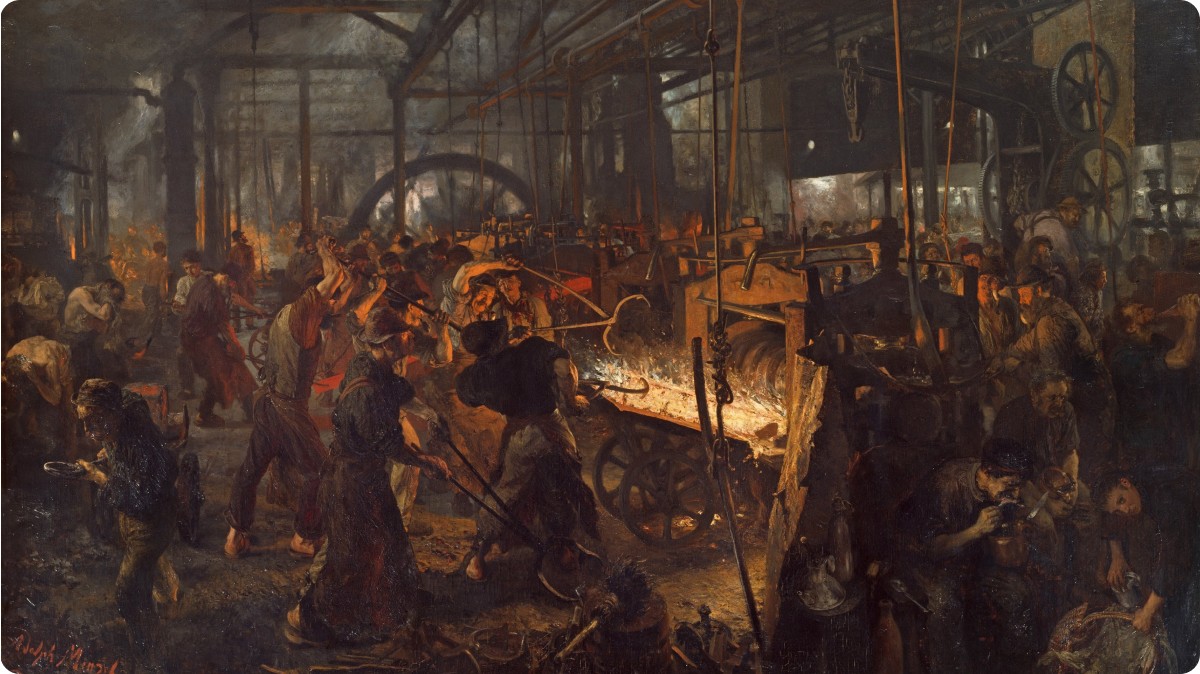
(Image: Adolph Menzel, The Iron Rolling Mill (Eisenwalzwerk / Modern Cyclopes), 1872–1875. Oil on canvas. Alte Nationalgalerie, Berlin.)
The answer is the largest under-digitised operational surface on Earth. A €2.5 trillion manufacturing base. 30.2 million industrial workers. 347,000 kilometres of Victorian water mains. Waste streams that are forty percent hand-sorted. Energy grids being rewired across twenty-seven regulatory regimes simultaneously. A $4 trillion digitisation gap inside a single economic bloc, with the deepest STEM pipeline outside China, and policy capital being deployed at a scale Americans find difficult to comprehend: €43 billion for chips, €200 billion for AI infrastructure, £104 billion for water alone.
The talent exists. It's being wasted. In the UK's 2023 survey of top graduate employers, 6,700 graduates went into consulting and professional services. 2,900 went into engineering and industrial companies. Europe doesn't have a talent problem. It has a deployment problem. The engineers are sitting in the wrong rooms. (I wrote about it here)
William of Sens didn't send Canterbury a whitepaper about French Gothic. He showed up with his tools, his body and he built it. The medieval system worked because knowledge was embodied, not abstracted. And the companies that are going to build monopolies in European industry over the next decade are the ones that understand this: Not dashboards sold from cushy SF offices. We need forward-deployed engineers on factory floors, in recycling plants, on construction sites, inside the ugly, regulated, operationally dense terrain that no one in Palo Alto wants to touch.
This is already happening and it's called: forward-deployed engineering, or FDE. While Palantir pioneered the term in enterprise software, it is evolving into something structurally different in Europe. Something that looks less like a consulting engagement and more like a medieval lodge.
PhysicsX, founded in London by former Formula 1 engineering leaders, spent three years in stealth before emerging with $32 million and a technology that replaces computationally expensive physics simulations with deep learning models running up to a million times faster. Robin Tuluie, its chairman, was Chief Scientist at Mercedes F1, helping win four World Championships. Jacomo Corbo, its CEO, was Chief Race Strategist at Renault F1 and co-founded QuantumBlack, the AI firm later acquired by McKinsey. The founding team carries the accumulated knowledge of the most data-intensive physical engineering environments on Earth. Their own blog describes its "PX Delivery" model: forward-deployed engineering teams working "shoulder-to-shoulder with customers to solve real-world challenges and prove the value of AI in production." They have raised over $187 million. Revenue has more than quadrupled in two years and they are building the equivalent of a Bauhütte for industrial physics, serving clients like SpaceX.
Matta, spun out of the University of Cambridge's Institute for Manufacturing in 2022, is putting AI eyes on factory production lines. Its co-founder Doug Brion holds a PhD in deep learning-enabled control. The company installs cameras, trains unsupervised AI models that achieve over ninety-nine percent defect-detection accuracy from as little as ten minutes of data, and goes live within hours. They explicitly hire Forward Deployed Engineers. A job posting reads: "You'll work across the entire customer journey: deploying software and hardware on factory floors (Haribo one day, aerospace the next)." They add roughly two new factory installations per month with three hundred factories in the pipeline. Matta's FDEs rotate between factory floors the way Villard de Honnecourt rotated between cathedral sites.
Rowden, in Bristol, is the defence variant. Founded by Rob Harper MBE, a former Army corporal, the company builds advanced sensing, communications, and electronic warfare systems for environments where conventional IT fails. Largely bootstrapped on less than a million in external funding, Rowden hit £20.4 million in revenue in 2024 with a claimed 130 percent compound annual growth rate. It ranked thirteenth on the Sunday Times 100 Tech list. Its engineers deliver complex integration programmes directly for military customers, often requiring security clearance, manufacturing hardware in-house on a sovereign UK supply chain. When your product is a decoy platform that confuses enemy radar, you don't deploy it from a dashboard.
AUAR, co-founded by Mollie Claypool and Gilles Retsin, is probably the closest literal thing to a Bauhütte. The company ships containerised robotic micro-factories with ABB robotic arms, machine vision, and proprietary MasterBuilder software directly to where homes need to be built. Each micro-factory arrives with what AUAR calls Field Ops: an operator, a literal master builder, who runs production on location. The full timber structure of a house is manufactured in under twelve hours, cutting costs by up to forty percent and on-site labour by seventy-five percent. They completed their first fully robotically manufactured building for construction group Vandenbussche in Belgium, then shipped two micro-factories to the US Midwest with Rival Holdings, each capable of producing 180 homes a year. The model is explicitly distributed: not one centralised factory but a growing network of local micro-factories, each learning from every build and feeding improvements back into the software. The lodge ships in a container.
Isembard, in London applies the same logic to manufacturing. Founded by Alexander Fitzgerald, the company builds and operates its own modular factories powered by proprietary MasonOS software. Their approach is to run the factory yourself first, absorb every operational problem into the software, then franchise the system out. Every part Isembard machines, every bottleneck its engineers hit on the factory floor, feeds back into MasonOS and makes the next factory faster, cheaper, and more capable. They staffed the team with ex-Palantir and Rolls-Royce engineers. The first factory opened in London in January 2025. Franchisees are already operating Isembard factories. Rowden is a customer.
Monumental, in Amsterdam, deploys autonomous bricklaying robots on active construction sites. Its co-founder Salar al Khafaji previously founded Silk, which was acquired by Palantir in 2016, a direct lineage to the FDE model. The company doesn't sell robots. It operates as a subcontractor, charging per brick laid, with a human bricklayer always present alongside the machine. It has built facades for houses, canal retaining walls, and social housing across the Netherlands for multiple top-25 general contractors. They raised $25 million in 2024. The team grew 148 percent in twelve months. The robot is on the site because that is where bricks are.
Recycleye and Greyparrot, both in London, are physically embedding AI inside waste sorting facilities. Recycleye builds robotic waste-picking systems achieving over ninety-nine percent end-purity while halving costs versus manual sorting, deployed across the UK, Germany, France, and beyond. Greyparrot installs camera units on conveyor belts tracking over twenty-five billion waste objects annually across twenty countries, covering sixty percent of the European waste management market. Both require physical engineering teams for installation, calibration, and integration, because waste is forty percent hand-sorted and the geometry of a recycling plant in Hamburg is different from one in Leeds, the same way the limestone at Chartres is different from the sandstone at Strasbourg.
EthonAI in Zürich, an ETH spin-off, combines visual quality inspection with causal root-cause analysis across factories for Siemens, Lindt, and Bosch. Cognite in Oslo, valued at $1.6 billion, deploys implementation teams and embedded fellows at oil platforms and power plants for TotalEnergies, Saudi Aramco, and BP. GridBeyond in Dublin installs on-site energy hardware across UK, Irish, and US facilities, navigating multiple European regulatory regimes. Daedalus in Karlsruhe, founded by OpenAI's first engineering hire, doesn't embed in someone else's factory, it itself is the factory, AI-controlled CNC manufacturing serving semiconductor and aerospace customers.
The pattern is always the same. Deploy engineers into the territory. Give them authority. Let the infrastructure compound.
Silicon Valley builds products that scale by removing the human from the loop. The European industrial opportunity scales by putting the engineer back in. A steel mill in the Ruhr Valley, a water utility in Yorkshire, a recycling plant in Île-de-France, an energy grid being rewired under twenty-seven different regulatory frameworks. They are problems you solve by showing up and understanding the local stone.
The medieval master builder was a practitioner embedded in the terrain, adapting in real time, carrying accumulated knowledge from site to site, compounding capability with every project. Pierre de Montreuil, who worked on both Saint-Denis and Notre-Dame de Rouen, was buried with the title doctor lathomorum or "Doctor of Masons", the only medieval builder known to receive such an honor. The value he created outlasted him by eight centuries.
The forward-deployed engineers building Europe's industrial future are his direct descendants. They understand that the gap between AI capability and operational reality can only be closed by a human standing at the point of contact, adapting the technology to the terrain.
And the terrain they are working on, $3 trillion of manufacturing, $12 trillion of construction, is the largest under-digitised operational surface in the developed world.
The cathedrals are still standing.
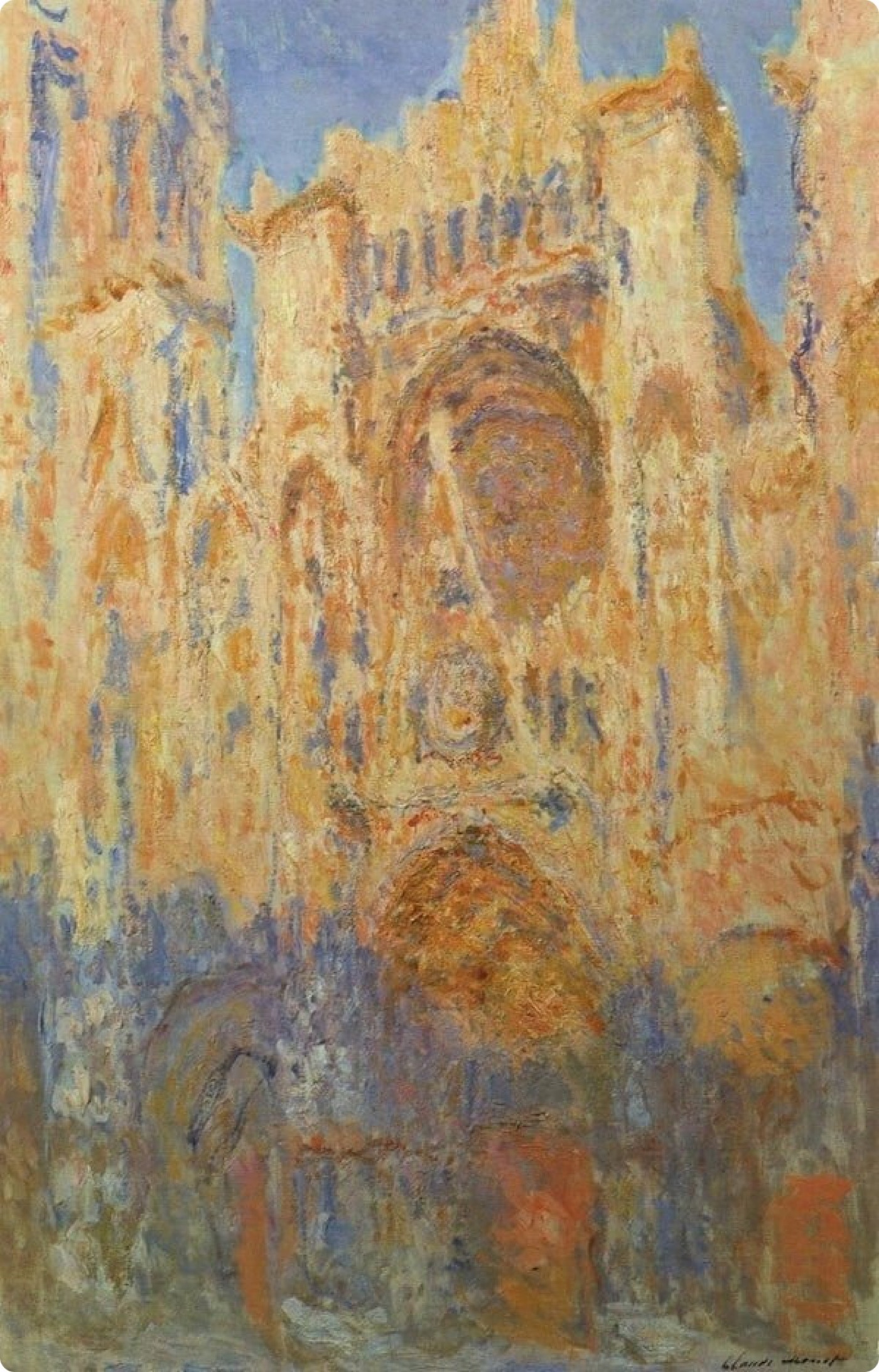
(Image: Claude Monet, (Notre-Dame de) Rouen Cathedral: The Portal in Sun, 1894. Oil on canvas. Musée d'Orsay, Paris.)
Braindump by Josef Chen